When I Was A Young Newspaper Journalist I Interviewed A Holocaust Survivor Who Lived In Southern Maryland
For those who died, for those who survived, for Jews today who are alive, we remember the millions who were targeted. However, we see that peace and love are still elusive concepts at times, even as mankind and people profess an unwavering love of, and servitude to, God.
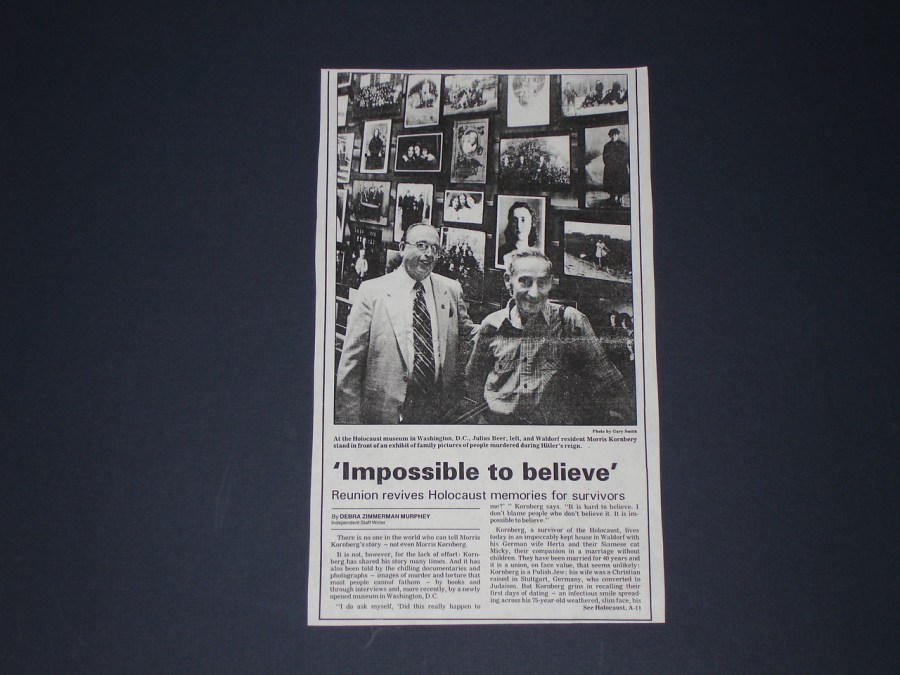
When I worked as a newspaper reporter decades ago at The Maryland Independent, I interviewed a Holocaust survivor, Morris Kornberg of Waldorf, Md. He was a gentle and small man who was just beginning to more publicly share his experiences. To open that vault.
To settle the truth with strangers and history.
Kornberg survived multiple concentration camps. I spent hours at his home interviewing him and meeting his wife and cat in a rustic suburban home in a bucolic and unremarkable neighborhood in Charles County, Md., in 1993.
The next day we went to the Holocaust Museum in D.C. It was the first time I had been. It is an unequalled and quieting encounter with the starkness of a seemingly impossible past.
Kornberg had been reunited that week with a friend he had met at Auschwitz, where they were “bunkmates” and toiled as coal miners but were eventually separated and lost touch. A group of us went to the museum, including the paper’s photographer Gary Smith and he shot some incredible photographs.
Reunited years later through efforts of the Red Cross, it was silencing to see and hear what the two men had lived through … and yet become aware that they were still somehow intact physically, mentally and spiritually. They were men who had been hated only because of who they were and their beliefs and cultural identities, but they had rebuilt their lives.
They had miraculously moved forward.
I consider knowing and meeting Morris, hearing his story and visiting the museum one of the most meaningful opportunities I had as a journalist and a human. To sit on a couch across from this man and to speak to him and to see his soul and to see kindness when he had survived a searing Zeitgeist of hatred — a hugely tangible utterance of man’s inhumanity — is impossible to condense in words.
The Nazis mechanized killing people. But they needed anti-Semitism as a fuel. My ancestry is German and Christian, and I married a Jewish man whose Polish relatives (on one side of his family) were shot over a pit in the countryside during the Holocaust. The bridges we’ve had to cross to accept each other’s perspectives, lineage and different experiences are the essence of what it means to value all kinds of people and all kinds of beings and faiths.
I saw a similar resolve as the cat sat with Morris. The resolve of compassion. There is no doubt that my and Maury’s love for and care of animals, nature and wildlife define us and has set us apart from others, but also forced us to search how we see the world and how a person can care about others and help other beings survive while also having a profession that is meaningful.
It has required we work as a team despite our challenges and inherent natures, and that we recognize compromise is necessary because communications is one of the most powerful and also misused tools people have.
So that brings me to sharing this:
“I still believe in man in spite of man. I believe in language even though it has been wounded, deformed, and perverted by the enemies of mankind. And I continue to cling to words because it is up to us to transform them into instruments of comprehension rather than contempt. It is up to us to choose whether we wish to use them to curse or to heal, to wound or to console.”
— Elie Wiesel
 Debra Zimmerman Murphey